FLD backward Euler · 8³ cells
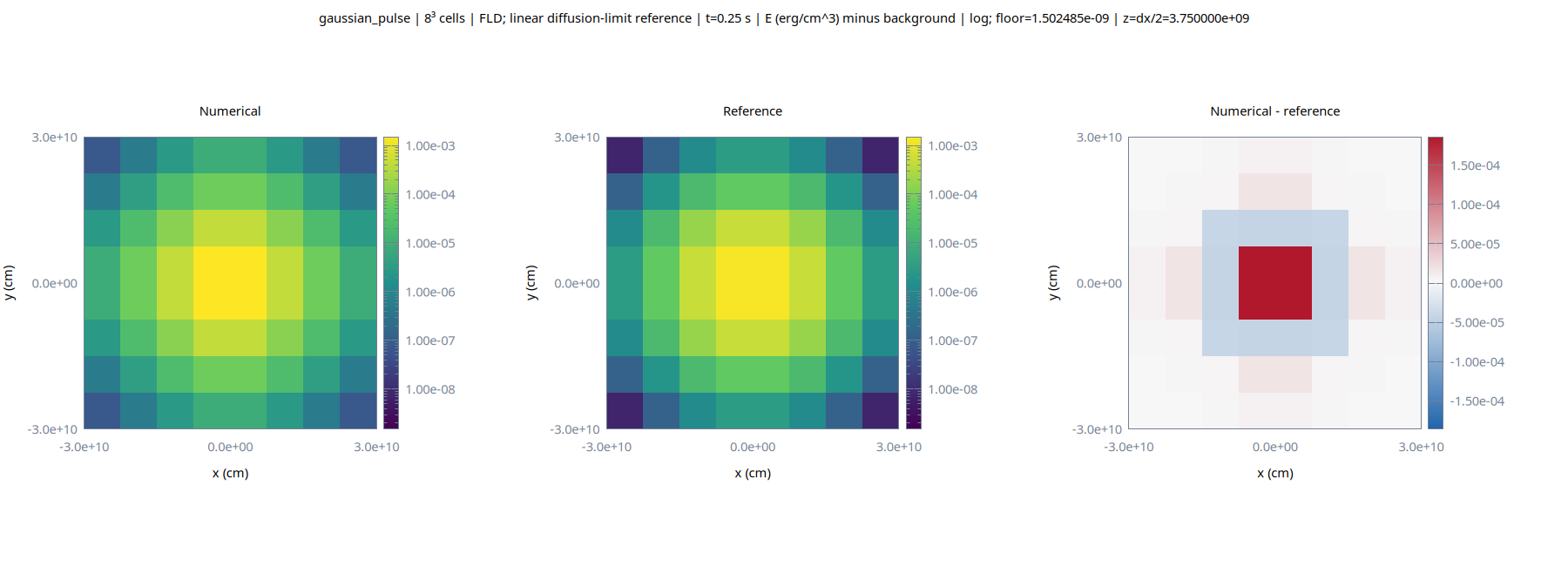
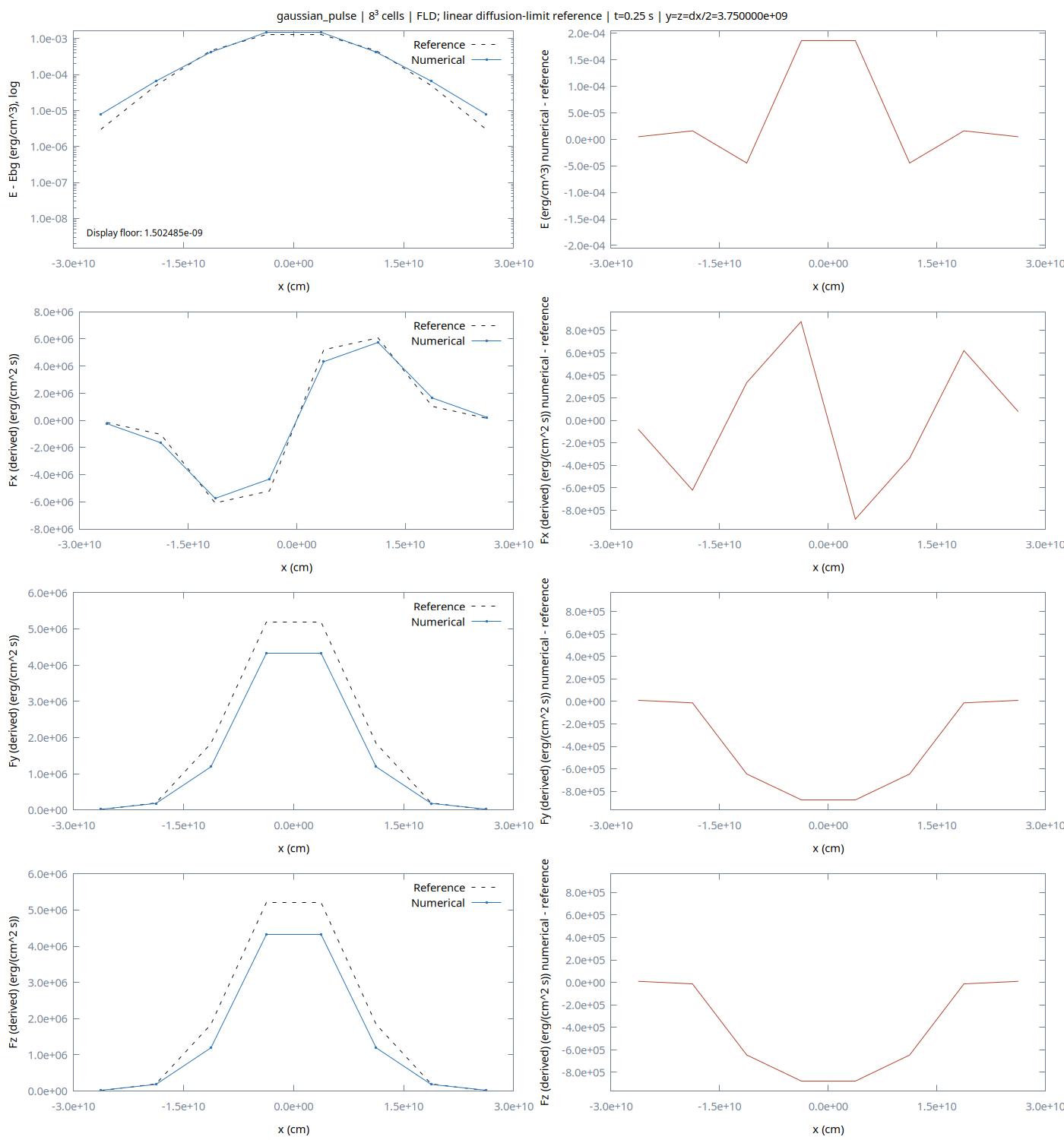
Central cell layer at z=dx/2; ray at y=z=dx/2.
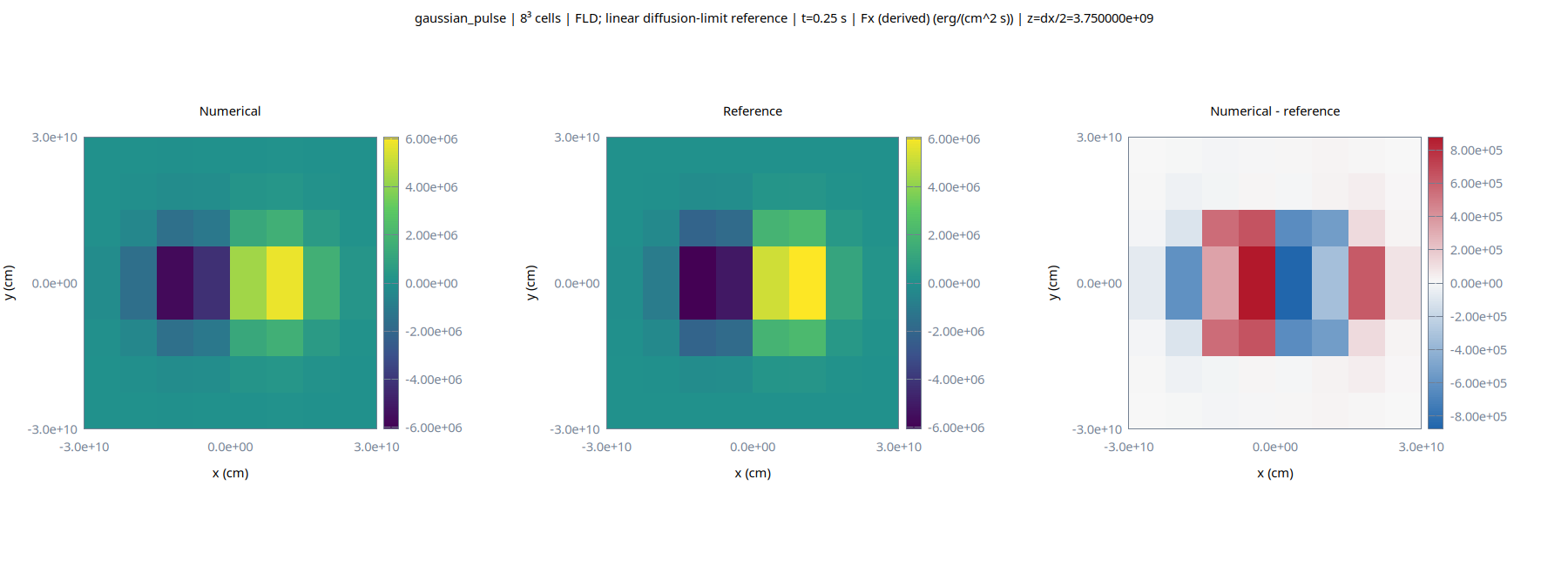
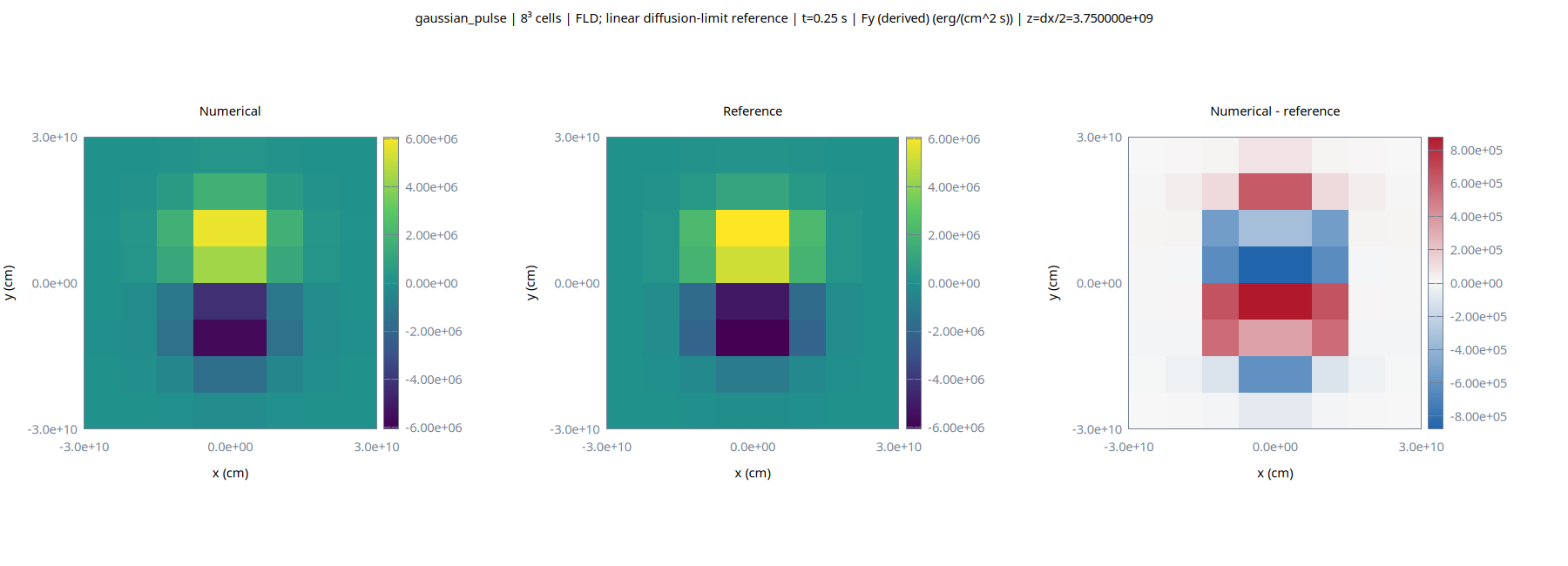
FLD backward Euler with the Levermore-Pomraning limiter; stationary material and physical c = 29979245800 cm/s. Radiation flux is derived from the radiation-energy gradient; it is a diagnostic, not an evolved momentum variable. Analytic references describe the linear diffusion limit and need not solve nonlinear flux-limited diffusion exactly. M1 versus FLD differences compare distinct radiation models and are not analytic-reference errors.
Recorded setup and run provenance
| Origin | Octo-TIGER application |
|---|---|
| Domain | Cube of side 6.000000e+10 cm; centered at the origin |
| Resolution | 8³ cells; finest Δx = 7.500000e+09 cm |
| Final comparison time | 2.500000e-01 s |
| Radiation model | FLD |
| Radiation integration | FLD backward Euler (first order in time) |
| Flux semantics | Derived FLD flux: F = -D grad E |
| Analytic reference | periodic-constant-diffusion; linear diffusion-limit reference, not exact for the nonlinear FLD limiter |
| Reference norm scope | Area-weighted projected positive-side slice; no full-volume norm or convergence order inferred |
| Radiation backend | cpu |
| Physical light speed | 2.997925e+10 cm/s |
| Reduced-speed factor α | 1.000000e+00 |
| Radiation transport speed | 2.997925e+10 cm/s |
| Periodic boundaries | on |
| Hydrodynamics | off |
| Gravity | off |
| Implicit radiation source | on |
| Uniform grid | on |
| CFL | 0.4 |
| Timestep cap | 0.025000000000000001 s |
| Output interval | 0.125 s |
| Background energy density | 1 erg/cm³ |
| Scattering coefficient χ | 1.6666666666666666e-10 cm⁻¹ |
| Gaussian width w | 6000000000 cm |
| Pulse amplitude A | 0.01 erg/cm³ |
{
  "background": 1.0,
  "c": 29979245800.0,
  "case": "gaussian_pulse",
  "cells": 8,
  "command": [
    "/home/dmarce1/workspace/octotiger/output/m1-fld-local-20261013-go/.campaign/launch-solver",
    "/home/dmarce1/workspace/octotiger/output/m1-fld-local-20261013-go/.campaign/runtime/octotiger",
    "--config_file=/home/dmarce1/workspace/octotiger/output/m1-fld-local-20261013-go/runs/l0/gaussian_pulse/fld/gaussian_pulse/l0/run.ini",
    "--hpx:threads=24"
  ],
  "comparison_signature": {
    "atomic_mass": "1",
    "atomic_number": "1",
    "cfl": "0.4",
    "code_to_cm": "1",
    "code_to_g": "1",
    "code_to_s": "1",
    "disable_analytic": "on",
    "disable_diagnostics": "on",
    "eos": "IDEAL",
    "gravity": "off",
    "hard_dt": "0.025000000000000001",
    "hydro": "off",
    "hydro_device_kernel_type": "OFF",
    "hydro_host_kernel_type": "LEGACY",
    "monopole_device_kernel_type": "OFF",
    "multipole_device_kernel_type": "OFF",
    "n_species": "1",
    "omega": "0",
    "periodic": "on",
    "problem": "RADIATION_GAUSSIAN_PULSE",
    "rad_implicit": "on",
    "rad_test_amplitude": "0.01",
    "rad_test_background": "1",
    "rad_test_chi": "1.6666666666666666e-10",
    "rad_test_luminosity": "2.6981321220000001e+29",
    "rad_test_width": "6000000000",
    "radiation": "on",
    "radiation_algorithm_version": 1,
    "radiation_integrator": "backward_euler",
    "radiation_limiter": "levermore_pomraning",
    "radiation_model": "fld",
    "radiation_reduced_c_factor": "1",
    "stop_step": "100000",
    "stop_time": "0.25",
    "unigrid": "on",
    "xscale": "30000000000"
  },
  "config": {
    "atomic_mass": "1",
    "atomic_number": "1",
    "cfl": "0.4",
    "code_to_cm": "1",
    "code_to_g": "1",
    "code_to_s": "1",
    "datadir": "/home/dmarce1/workspace/octotiger/output/m1-fld-local-20261013-go/runs/l0/gaussian_pulse/fld/gaussian_pulse/l0/",
    "disable_analytic": "on",
    "disable_diagnostics": "on",
    "disable_output": "off",
    "eos": "IDEAL",
    "gravity": "off",
    "hard_dt": "0.025000000000000001",
    "hydro": "off",
    "hydro_device_kernel_type": "OFF",
    "hydro_host_kernel_type": "LEGACY",
    "max_level": "0",
    "min_level": "0",
    "monopole_device_kernel_type": "OFF",
    "multipole_device_kernel_type": "OFF",
    "n_species": "1",
    "odt": "0.125",
    "omega": "0",
    "periodic": "on",
    "problem": "RADIATION_GAUSSIAN_PULSE",
    "rad_implicit": "on",
    "rad_reference": "/home/dmarce1/workspace/octotiger/output/m1-fld-local-20261013-go/runs/l0/gaussian_pulse/fld/gaussian_pulse/l0/reference.bin",
    "rad_test_amplitude": "0.01",
    "rad_test_background": "1",
    "rad_test_chi": "1.6666666666666666e-10",
    "rad_test_luminosity": "2.6981321220000001e+29",
    "rad_test_width": "6000000000",
    "radiation": "on",
    "radiation_backend": "cpu",
    "radiation_integrator": "backward_euler",
    "radiation_limiter": "levermore_pomraning",
    "radiation_model": "fld",
    "radiation_reduced_c_factor": "1",
    "stop_step": "100000",
    "stop_time": "0.25",
    "unigrid": "on",
    "xscale": "30000000000"
  },
  "conservation": [
    {
      "boundary": 0.0,
      "boundary_fraction": 0.0,
      "field": "er",
      "final": 2.1601202758847317e+32,
      "final_fraction": 1.0,
      "history_end_time": 0.25,
      "history_scope": "full_run",
      "history_start_time": 0.0,
      "initial": 2.1601202758847317e+32,
      "initial_fraction": 1.0,
      "integral_units": "erg",
      "max_abs_residual": 0.0,
      "max_normalized_error": 0.0,
      "normalization_basis": "abs(initial_energy)",
      "normalization_scale": 2.1601202758847317e+32,
      "normalization_time": 0.0,
      "normalized_error": 0.0,
      "normalized_residual": 0.0,
      "raw_change": 0.0,
      "residual": 0.0,
      "source": 0.0,
      "source_fraction": 0.0,
      "zero_initial_flux_relative_tolerance": 1.4210854715202004e-14
    }
  ],
  "dx": 7500000000.0,
  "executable_sha256": "82854f6db866ae424dd0b4608d8c6b9b4828b28e4d5f30f48d358097d19ab303",
  "fld_diagnostics": {
    "accepted_steps": 10,
    "history_end_time": 0.24999999999999997,
    "history_start_time": 0.0,
    "maximum_nonlinear_residual": 2.488512786229625e-11,
    "maximum_step_coupled_conservation_error": 3.747002670520111e+15,
    "radiation_energy_budget": {
      "boundary": 0.0,
      "boundary_fraction": 0.0,
      "field": "er",
      "final": 2.1601202758847317e+32,
      "final_fraction": 1.0,
      "history_end_time": 0.25,
      "history_scope": "full_run",
      "history_start_time": 0.0,
      "initial": 2.1601202758847317e+32,
      "initial_fraction": 1.0,
      "integral_units": "erg",
      "max_abs_residual": 0.0,
      "max_normalized_error": 0.0,
      "normalization_basis": "abs(initial_energy)",
      "normalization_scale": 2.1601202758847317e+32,
      "normalization_time": 0.0,
      "normalized_error": 0.0,
      "normalized_residual": 0.0,
      "raw_change": 0.0,
      "residual": 0.0,
      "source": 0.0,
      "source_fraction": 0.0,
      "zero_initial_flux_relative_tolerance": 1.4210854715202004e-14
    },
    "reference_exact_for_solver": false,
    "reference_kind": "linear-diffusion-limit",
    "reference_norm_scope": "projected-positive-side-slice",
    "retries": 0,
    "slice_reference_norms": {
      "er": {
        "L1": 2.3122970273976168e-05,
        "L2": 5.06472522655236e-05,
        "Linf": 0.00018618756762545097
      },
      "fx": {
        "L1": 209239.86066072763,
        "L2": 354243.0529966604,
        "Linf": 878335.8289378304
      },
      "fy": {
        "L1": 209239.86066072775,
        "L2": 354243.0529966605,
        "Linf": 878335.8289378313
      },
      "fz": {
        "L1": 160130.79792448232,
        "L2": 326143.67134694365,
        "Linf": 878335.8289564699
      }
    },
    "steps": [
      {
        "boundary_energy": 0.0,
        "conservation_error": 3.747002670520111e+15,
        "dt": 0.025,
        "linear_iterations": 3,
        "linear_residual": 4.2405007778000885e-11,
        "nonlinear_iterations": 1,
        "nonlinear_residual": 2.488512786229625e-11,
        "retries": 0,
        "substeps": 1,
        "t": 0.0,
        "vcycles": 3
      },
      {
        "boundary_energy": 0.0,
        "conservation_error": 655725512450202.5,
        "dt": 0.025,
        "linear_iterations": 3,
        "linear_residual": 4.535120545016438e-11,
        "nonlinear_iterations": 1,
        "nonlinear_residual": 1.863611877559552e-11,
        "retries": 0,
        "substeps": 1,
        "t": 0.025,
        "vcycles": 3
      },
      {
        "boundary_energy": 0.0,
        "conservation_error": 2.810251995123053e+15,
        "dt": 0.025,
        "linear_iterations": 3,
        "linear_residual": 5.062727687269407e-11,
        "nonlinear_iterations": 1,
        "nonlinear_residual": 1.4021073350425618e-11,
        "retries": 0,
        "substeps": 1,
        "t": 0.05,
        "vcycles": 3
      },
      {
        "boundary_energy": 0.0,
        "conservation_error": 2.4355517737278245e+15,
        "dt": 0.025,
        "linear_iterations": 3,
        "linear_residual": 5.7385308173651216e-11,
        "nonlinear_iterations": 1,
        "nonlinear_residual": 1.0597774451179342e-11,
        "retries": 0,
        "substeps": 1,
        "t": 0.07500000000000001,
        "vcycles": 3
      },
      {
        "boundary_energy": 0.0,
        "conservation_error": -655725464054946.5,
        "dt": 0.025,
        "linear_iterations": 3,
        "linear_residual": 6.404212938034452e-11,
        "nonlinear_iterations": 1,
        "nonlinear_residual": 8.045686118740438e-12,
        "retries": 0,
        "substeps": 1,
        "t": 0.1,
        "vcycles": 3
      },
      {
        "boundary_energy": 0.0,
        "conservation_error": 1.030425698282138e+15,
        "dt": 0.025,
        "linear_iterations": 3,
        "linear_residual": 6.924646107407507e-11,
        "nonlinear_iterations": 1,
        "nonlinear_residual": 6.1366421569979314e-12,
        "retries": 0,
        "substeps": 1,
        "t": 0.125,
        "vcycles": 3
      },
      {
        "boundary_energy": 0.0,
        "conservation_error": -2.529226881303452e+15,
        "dt": 0.025,
        "linear_iterations": 3,
        "linear_residual": 7.247688167971818e-11,
        "nonlinear_iterations": 1,
        "nonlinear_residual": 4.700363270650236e-12,
        "retries": 0,
        "substeps": 1,
        "t": 0.15,
        "vcycles": 3
      },
      {
        "boundary_energy": 0.0,
        "conservation_error": -93675098835320.0,
        "dt": 0.025,
        "linear_iterations": 3,
        "linear_residual": 7.391019761794937e-11,
        "nonlinear_iterations": 1,
        "nonlinear_residual": 3.616767452333666e-12,
        "retries": 0,
        "substeps": 1,
        "t": 0.175,
        "vcycles": 3
      },
      {
        "boundary_energy": 0.0,
        "conservation_error": 187350146569048.0,
        "dt": 0.025,
        "linear_iterations": 3,
        "linear_residual": 7.39989573517223e-11,
        "nonlinear_iterations": 1,
        "nonlinear_residual": 2.794594378445632e-12,
        "retries": 0,
        "substeps": 1,
        "t": 0.19999999999999998,
        "vcycles": 3
      },
      {
        "boundary_energy": 0.0,
        "conservation_error": 3.465977470973064e+15,
        "dt": 0.025,
        "linear_iterations": 3,
        "linear_residual": 7.31821960581184e-11,
        "nonlinear_iterations": 1,
        "nonlinear_residual": 2.168066272278809e-12,
        "retries": 0,
        "substeps": 1,
        "t": 0.22499999999999998,
        "vcycles": 3
      }
    ],
    "substeps": 10
  },
  "inx": 8,
  "length": 60000000000.0,
  "level": 0,
  "movie_capture": {
    "hard_dt": 0.025,
    "odt": 0.125,
    "requested_snapshots": 3,
    "steps_per_output_check": 5
  },
  "origin": "Octo-TIGER application",
  "physical_c": 29979245800.0,
  "radiation_algorithm_version": 1,
  "radiation_backend": "cpu",
  "radiation_equations": "stationary physical-c FLD",
  "radiation_flux_semantics": "derived_fld_flux",
  "radiation_integrator": "backward_euler",
  "radiation_limiter": "levermore_pomraning",
  "radiation_model": "fld",
  "radiation_reduced_c_factor": 1.0,
  "reference_diffusion_coefficient": 5.99584916e+19,
  "reference_exact_for_solver": false,
  "reference_generator_sha256": "bba8ef1de664777cb12bc4301a1622a72298ba4702cd525007a41b30b34fc3c5",
  "reference_kind": "linear-diffusion-limit",
  "reference_model": "periodic-constant-diffusion",
  "reference_sampling": "cell averages",
  "reference_sha256": "dbb5cad328512e5129c3fdc7b1b9dd58c23eef55a783d7ece8eb68ebca834691",
  "status": "complete",
  "time": 0.25,
  "transport_c": 29979245800.0,
  "units": {
    "chi": "1/cm",
    "energy_density": "erg/cm^3",
    "flux": "erg/(cm^2 s)",
    "length": "cm",
    "luminosity": "erg/s",
    "mass": "g",
    "source": "erg/(cm^3 s)",
    "system": "CGS",
    "time": "s"
  },
  "validation_scope": "Periodic constant-D heat-equation reference for the represented initial energy, D=c/(3 chi), with derived F=-D grad(E). This is a diffusion-limit reference for nonlinear Levermore-Pomraning FLD; finite-gradient limiter differences remain even with vanishing numerical error. Reported errors are slice differences."
}
Derived FLD flux maps
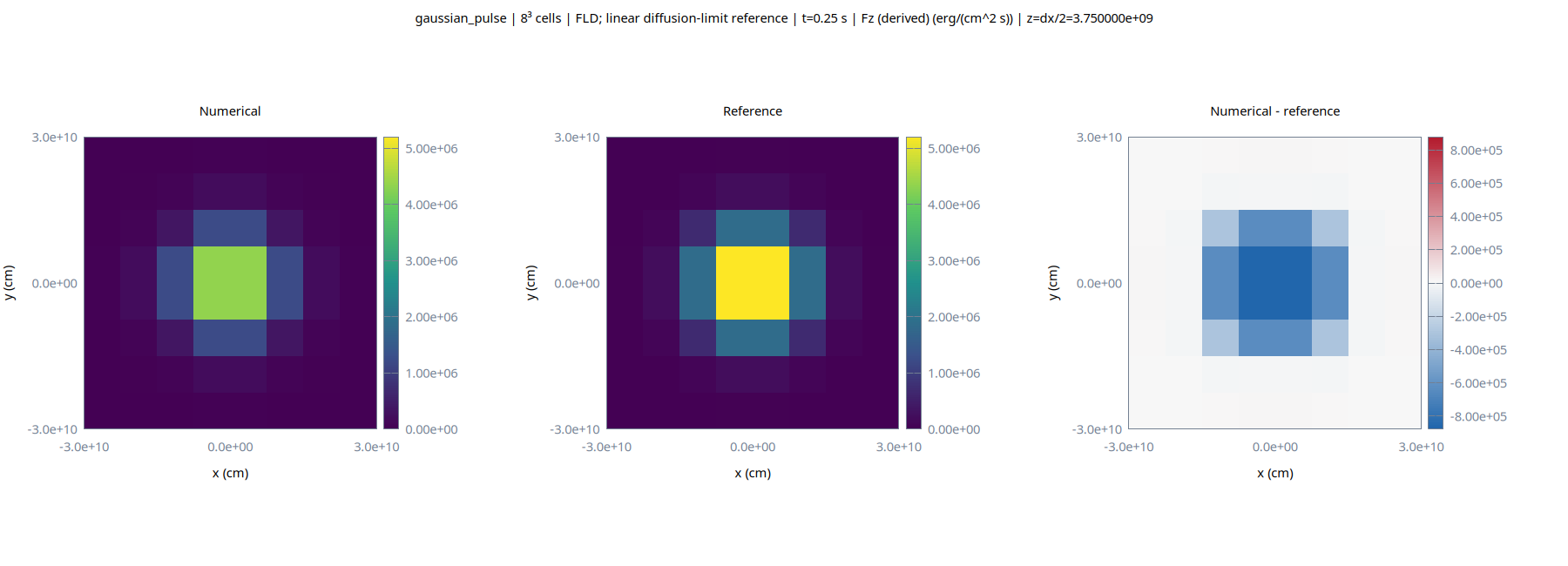
Accepted implicit solves
Accepted steps: 10; substeps: 10; timestep retries: 0; maximum nonlinear residual: 2.488513e-11; maximum absolute coupled energy error per accepted step: 3.747003e+15.
Projected-slice differences from the analytic reference
Area-weighted L1, L2, and maximum differences on the exported positive-side slice; these are not full-volume norms or a pure discretization error. No convergence order is inferred. Energy-density and flux units are those recorded in the slice-units download.
| Field | L1 difference | L2 difference | Maximum difference |
|---|---|---|---|
| er | 2.312297e-05 | 5.064725e-05 | 1.861876e-04 |
| fx | 2.092399e+05 | 3.542431e+05 | 8.783358e+05 |
| fy | 2.092399e+05 | 3.542431e+05 | 8.783358e+05 |
| fz | 1.601308e+05 | 3.261437e+05 | 8.783358e+05 |
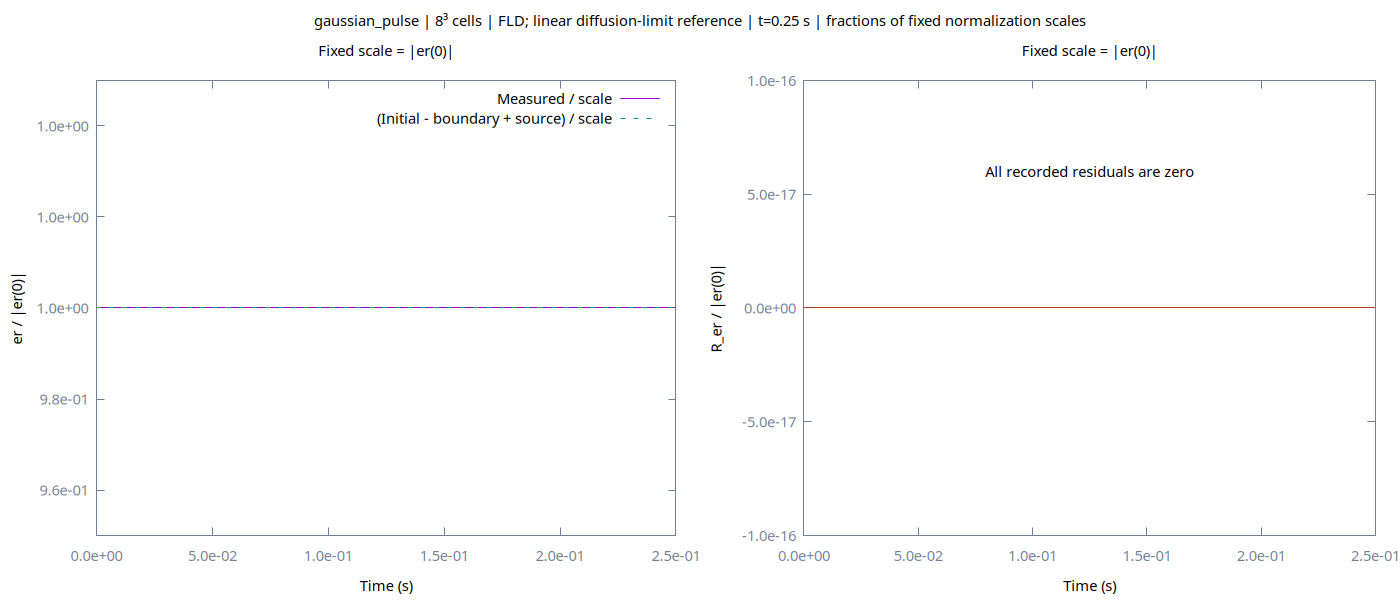
Radiation energy conservation
All values below are dimensionless fractions of the fixed normalization scale at t_ref = 0 s.
| Field | Scale | Q(t_ref)/scale | Q(t)/scale | Boundary B/scale | Source S/scale | Residual R/scale | Maximum |R|/scale |
|---|---|---|---|---|---|---|---|
| er | |Q(t_ref)| | 1.000000e+00 | 1.000000e+00 | 0.000000e+00 | 0.000000e+00 | 0.000000e+00 | 0.000000e+00 |
Saved-state movie
Gaussian Pulse · L0 · FLD backward Euler
3 stored states; 3 shown. Zero-order hold; no solution interpolation. Playback holds each saved numerical state over its time interval and includes endpoint holds.
Snapshot times: 0, 0.125, 0.25 s.
Arrows show derived FLD diagnostic flux -D grad(E); radiation momentum is not evolved. Arrows have equal length and show direction only.
Final-time profiles compare FLD with a linear diffusion-limit analytic reference, not an exact solution of nonlinear flux-limited diffusion. The movie shows numerical states only.
Central z=0+ radiation energy slice with faint cell mesh and equal-length flux direction arrows. Arrows show derived FLD diagnostic flux -D grad(E); radiation momentum is not evolved. Gaussian energy excess above the recorded background uses a labeled logarithmic floor. Fixed color limits; actual stored Silo times held without solution interpolation. Final-time profiles compare FLD with a linear diffusion-limit analytic reference, not an exact solution of nonlinear flux-limited diffusion. The movie shows numerical states only. The maps show the full simulation domain without cropping.
Download MP4 · Rendering and timing metadata · Full run report