Octo-TIGER / Radiation verification

Radiation test problems

M1 RK1 and stationary FLD. Open a problem for its physical setup, comparison method, sources, and results at every completed resolution.

All requested simulations and postprocessing are complete1 completed runsfld

FLD method scope. Stationary grey radiation at physical light speed, CPU backend, backward Euler in time, and derived flux with the Levermore–Pomraning limiter. Analytic diffusion-limit references are supplied, but their differences include nonlinear-limiter and boundary-model effects; they are not exact solutions of this nonlinear FLD solver. Paired M1 RK1 and FLD timings use different stability limits and do not establish performance at matched error.

Saved-state movie

Gaussian Pulse · L0 · FLD backward Euler

3 stored states; 3 shown. Zero-order hold; no solution interpolation. Playback holds each saved numerical state over its time interval and includes endpoint holds.

Snapshot times: 0, 0.125, 0.25 s.

Arrows show derived FLD diagnostic flux -D grad(E); radiation momentum is not evolved. Arrows have equal length and show direction only.

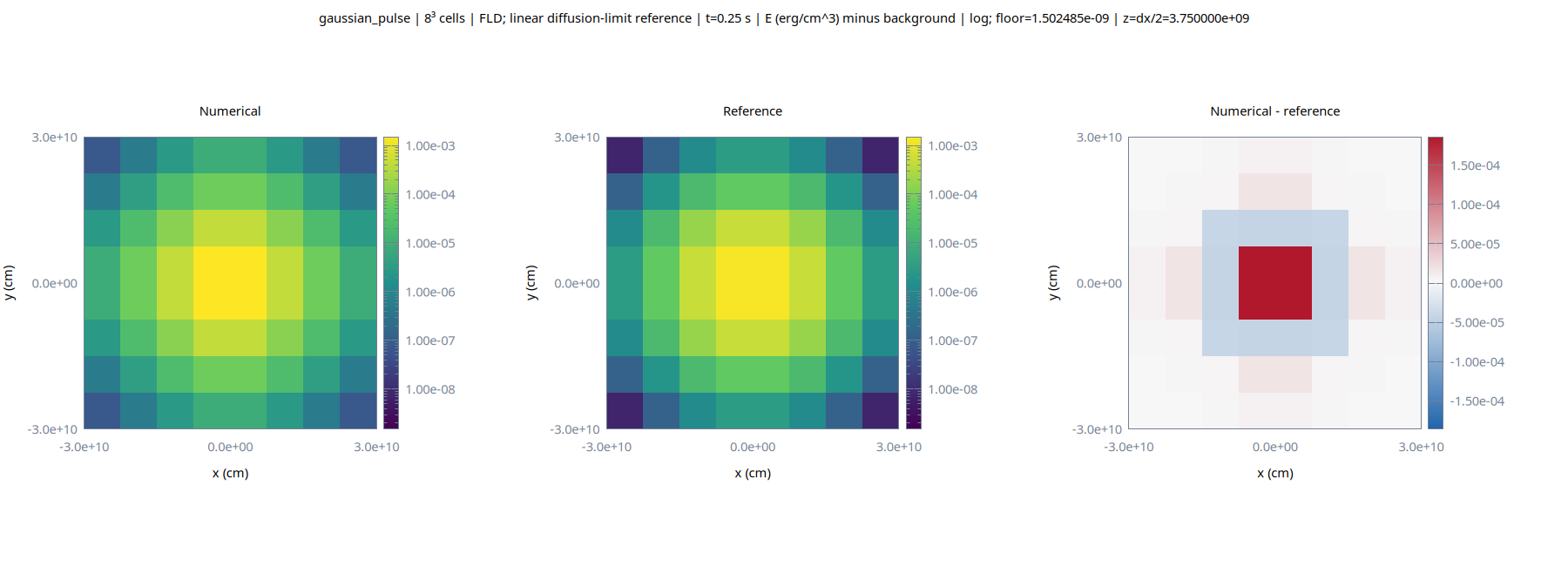
Final-time profiles compare FLD with a linear diffusion-limit analytic reference, not an exact solution of nonlinear flux-limited diffusion. The movie shows numerical states only.

Central z=0+ radiation energy slice with faint cell mesh and equal-length flux direction arrows. Arrows show derived FLD diagnostic flux -D grad(E); radiation momentum is not evolved. Gaussian energy excess above the recorded background uses a labeled logarithmic floor. Fixed color limits; actual stored Silo times held without solution interpolation. Final-time profiles compare FLD with a linear diffusion-limit analytic reference, not an exact solution of nonlinear flux-limited diffusion. The movie shows numerical states only. The maps show the full simulation domain without cropping.

Download MP4 · Rendering and timing metadata · Full run report
All campaign movies

Awaiting completed results
Exact transport

Streaming wave

Unsupported by the stationary FLD backend. A smooth, periodic radiation wave travels at the speed of light. Its phase and amplitude test transport accuracy.

0 completed resolutions

Setup & all results →
Awaiting completed results
Exact transport

Streaming front

Unsupported by the stationary FLD backend. A sharp, bright half-domain crosses a nearly dark background. Exact cell averages track both moving edges through the periodic box.

0 completed resolutions

Setup & all results →
Gaussian pulse energy comparison
Energy comparison · 8³ cells · t = 2.500000e-01 s
Stationary flux-limited diffusion

Gaussian pulse

A periodized Gaussian energy perturbation diffuses in a prescribed stationary scattering medium. Flux is derived from the energy gradient.

1 completed resolution

Setup & all results →
Awaiting completed results
Steady diffusion

Equilibrium sphere

Unsupported by the stationary FLD backend. A smooth spherical emitter balances outward radiation transport. An error-function solution describes its steady diffusion equilibrium.

0 completed resolutions

Setup & all results →
Awaiting completed results
Coupled radiation hydrodynamics

Subcritical radiative shock

Unsupported by the stationary FLD backend. Radiation heats gas ahead of a shock, forming a precursor whose gas temperature remains below the downstream equilibrium temperature.

0 completed resolutions

Setup & all results →
Awaiting completed results
Coupled radiation hydrodynamics

Supercritical radiative shock

Unsupported by the stationary FLD backend. A faster shock produces a stronger radiative precursor. Gas ahead of the shock approaches the downstream equilibrium temperature.

0 completed resolutions

Setup & all results →
Awaiting completed results
Coupled radiation hydrodynamics

Radiating blast wave

Unsupported by the stationary FLD backend. A spherical energy release drives a shock and radiation precursor into a radial atmosphere, evolved on a Cartesian mesh.

0 completed resolutions

Setup & all results →
Awaiting completed results
Stationary flux-limited diffusion

Marshak wave

An incoming radiation bath heats initially cold, stationary material through coupled nonlinear FLD and material energy exchange.

0 completed resolutions

Setup & all results →
Combined plot reportBatch metadata