All problem comparisons · Campaign
Radiating Blast: Euler and ADER2
Reference: no supplied analytic or digitized numerical profile. Ensman (1994), Figures 17–22, provide published numerical comparisons. Their curves are not embedded, and the original shell/deposition differs from this filled-core Cartesian adaptation. The Sedov–Taylor solution is not an analytic solution of this radiating setup.
Ensman (1994). Method-to-method differences below measure disagreement, not error against an exact solution. Per-method pages retain their numerical resolution comparisons.
Coupled ADER2 accuracy remains under investigation. A completed run or a small difference does not establish uniform second-order accuracy.
Revision 6 validation limits. Streaming-wave temporal-order thresholds failed at limiter transitions even with resolved references. Optically thick radiation temporal probes remain unresolved under the unchanged 1e-12 measurement guard. Strict stiff coupled temporal tests have not been rerun for revision 6 and remain an open limitation.
Level 2
Euler (first order): complete results, parameters and reference discussion
Coupled ADER2: complete results, parameters and reference discussion
matched. No other refinement level or physical time is substituted for a missing partner.
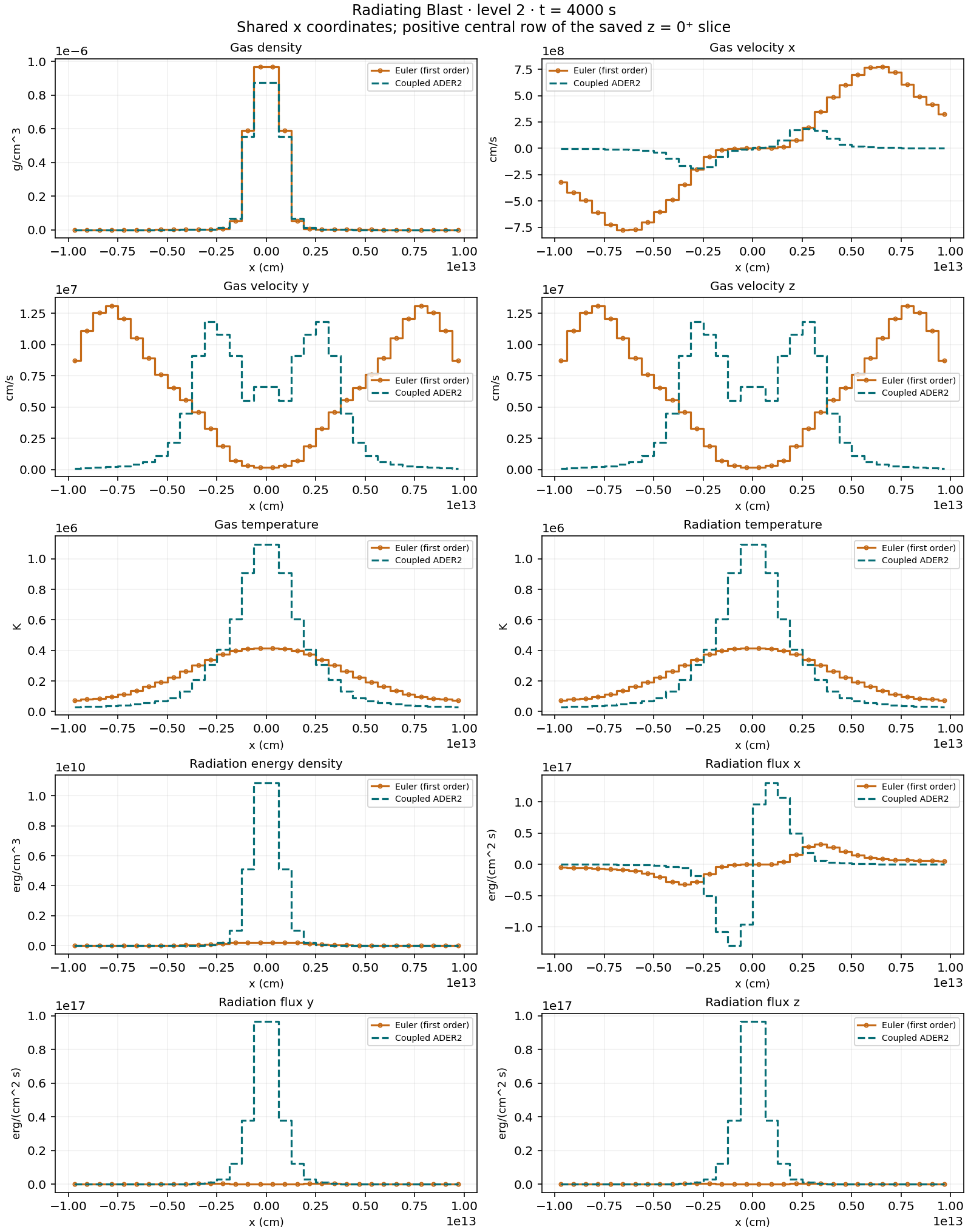
Matched profile coordinates and values (CSV)
ADER2 minus Euler: slice discrepancy
| Field | Units | L₁ | L₂ | L∞ |
|---|---|---|---|---|
| Gas density | g/cm^3 | 9.460956e-10 | 6.783819e-09 | 9.393518e-08 |
| Gas velocity x | cm/s | 3.131670e+08 | 3.933921e+08 | 8.384126e+08 |
| Gas velocity y | cm/s | 3.131670e+08 | 3.933921e+08 | 8.384126e+08 |
| Gas velocity z | cm/s | 9.179791e+06 | 9.716925e+06 | 1.469525e+07 |
| Gas temperature | K | 8.316133e+04 | 1.077853e+05 | 6.786417e+05 |
| Radiation temperature | K | 8.337959e+04 | 1.079146e+05 | 6.786417e+05 |
| Radiation energy density | erg/cm^3 | 1.052839e+08 | 8.082665e+08 | 1.063644e+10 |
| Radiation flux x | erg/(cm^2 s) | 8.718749e+15 | 1.708819e+16 | 1.296459e+17 |
| Radiation flux y | erg/(cm^2 s) | 8.718749e+15 | 1.708819e+16 | 1.296459e+17 |
| Radiation flux z | erg/(cm^2 s) | 1.100706e+15 | 7.173799e+15 | 9.643552e+16 |
Euler (first order) versus no supplied analytic or digitized numerical profile
No embedded reference curve is available; an analytic error cannot be computed.
Source slice CSV · Run metadata
Coupled ADER2 versus no supplied analytic or digitized numerical profile
No embedded reference curve is available; an analytic error cannot be computed.
Level 3
Euler (first order): complete results, parameters and reference discussion
Coupled ADER2: pending.
awaiting matching method. No other refinement level or physical time is substituted for a missing partner.
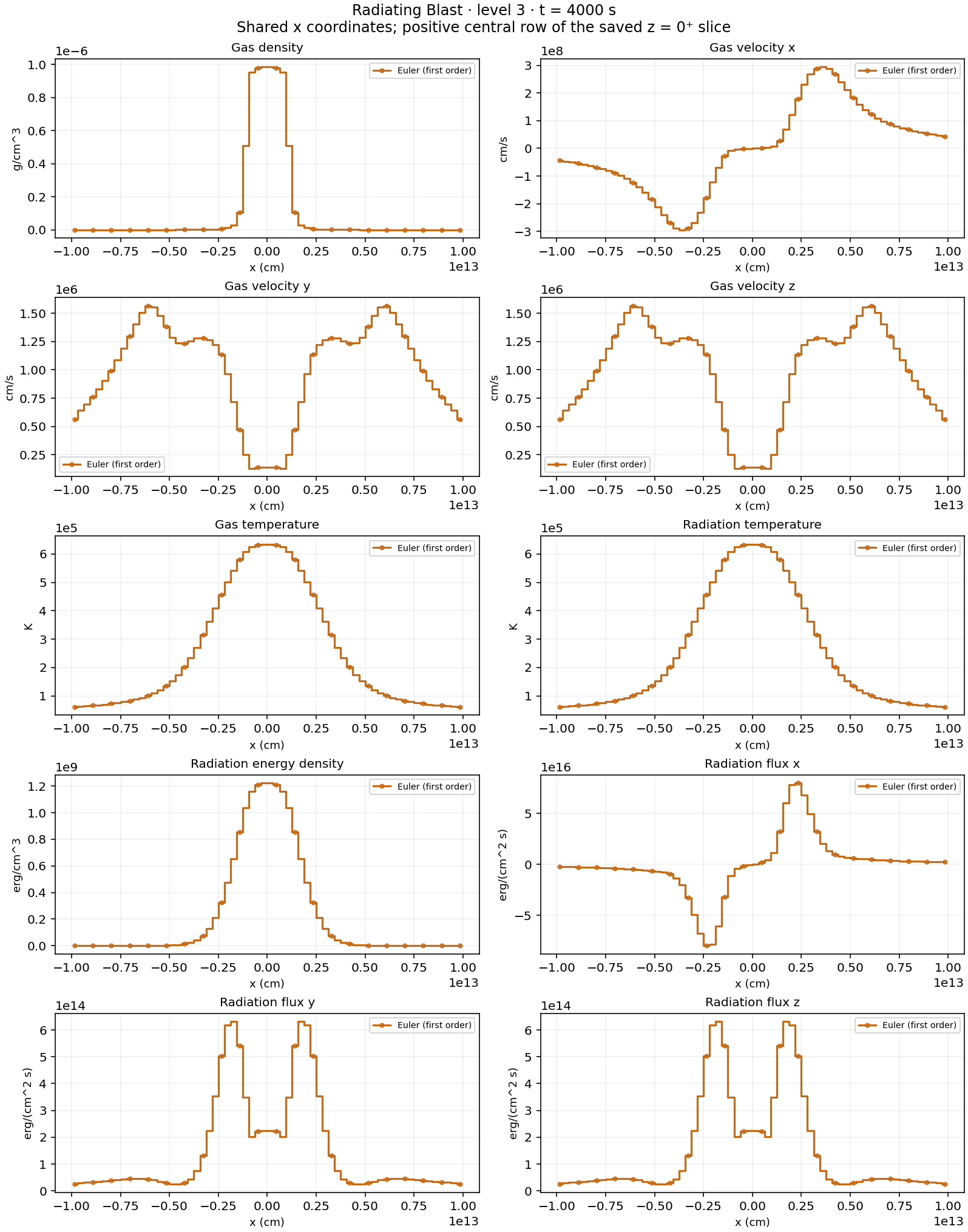
Matched profile coordinates and values (CSV)
Euler (first order) versus no supplied analytic or digitized numerical profile
No embedded reference curve is available; an analytic error cannot be computed.
Level 4
Euler (first order): pending.
Coupled ADER2: pending.
How these comparisons are measured
All field values use the saved units (CGS for the seven original problems; normalized units for Marshak). The central profiles share x coordinates and the positive row adjacent to y = z = 0. Adaptive leaf-cell averages are prolonged as constants onto the finest common Cartesian x-y partition, with no extrapolation or time interpolation. Different leaf sizes may average different z extents adjacent to the plane. The plotted curves therefore represent the saved finite-volume slices.
Slice L₁ is mean absolute difference, L₂ is root-mean-square difference, and L∞ is maximum absolute difference, with area weighting. These are two-dimensional slice diagnostics. The separately labeled solver norms cover the full volume.
Each method uses its own saved cell-average reference where supplied; finer meshes can change the sampled reference.